I haven't yet heard or read President Obama's "defiant defense" of his skewed and terrible tax cut deal with Republicans. So my opinion could conceivably change after watching him speak. But I've been following a little of the coverage, and none of it is good. I have yet to see a backing of the President by anyone that really matters in Washington. The possibility of the deal being rejected in either house is exciting, but also fraught with booby-trapped disasters for the 2012 reelection fight. I don't want Obama to fail or look weak, but I just can't support this proposal. It's terrible.
Why do the rich get two years of budget-busting tax cuts while the unemployment insurance scheme is only renewed for 13 months? It's such a lopsided deal. I understand that tax cuts need to be given or taken away in yearlong increments, but if unemployment expires in January 2012, in the depths of primary season, why would any Republican agree to any extension at all? It's going to be a disaster for Obama from Jan. 12 - Election Day.
Further, while Jeff commented in yesterday's post about the total breakdown of the Democratic party's messaging, and that I shouldn't only blame the President and his team, he's right. But the President is the leader of that team and this was an epic fail of leadership. It's kind of part and parcel with his legislative success and failure so far. I know he can't get what he wants simply because he wants it, and there is inherent risk in mimicking Bush and his steamroller, but Obama seems content to say he wants, say, a healthcare bill, and then he sits back for nine months without framing the issue at all as what is acceptable to him and then we get a crap sandwich, to paraphrase Boehner. Now, the result was certainly better than the absence of a bill, but think of what it could have been. Republicans were never going to support anything and prove that every day of the week. Assuming he could have massaged Lieberman and Ben Nelson earlier and more often, perhaps we could have gotten an even more effective, more progressive bill. They're going to rail and campaign against it anyway, so let's get as much as we can. Instead, concessions were given every time Republicans showed up and said hello. It's incredibly frustrating and counterproductive.
We'll see what happens next, with Republicans and Democrats both railing against the deal. But do they have the votes to stop it?
Wednesday, December 08, 2010


Tuesday, December 07, 2010

The "Deal"
Regarding President Obama's purported deal with Republicans over the Bush-era tax cuts on the wealthy, I think we as a nation are heading down a very dimly-lit alley. Raising taxes on 2% of Americans, the richest 2%, i.e. the ones who can go from a 36% to a 39% tax rate, is not a socialist, or evil or "job-killing" move. It is one of the only ways to claw out of the deficit hole we are in. That said, however, extending -- temporarily or permanently -- the Bush-era tax cuts for the middle class, i.e. 98% of Americans, also busts a hole in the deficit and does not help our long-term financial solvency. But it does begin to address a few class warfare elements seemingly embedded in our tax code; class warfare against the middle class that is. You see the rich don't pay remotely close to the rate they're supposed to pay. They have tax lawyers, and tax shelters and tax loopholes that the other 98% of Americans either don't have or can't afford to hire specialists to find. So the upper-class routinely pays a lower rate than the middle class. That is fundamentally unfair.
So I would be more inclined to support Obama's tax deal if we also agree to enforce the existing tax code like never before. No longer can Warren Buffet famously pay a lower tax rate than his middle-class secretary. No longer should there be such a lucrative business in tax law and obfuscation. If we allow the megarich to pay a lower tax rate of 36%, then let's actually make them pay 36% instead of 20% or lower once their hired help figure out all the loopholes they can jump through.
Since the Obama tax cut proposal earlier this year is actually a tax cut on everyone and not, as you would likely believe, only on people making less than $200,000 year as an individual and $250,000 a year as a family, people making from $250,000 - $500,000 a year actually would only pay $400 extra in taxes should the tax cuts for the wealthiest Americans expire. Even Bill Gates would get a tax cut, just on the first $250,000 he makes. Since 98% of Americans makes less than $250,000 a year, their whole incomes fall below the threshold, but once you make $250,001 a year, you fall into a separate class. That first $250,000 gets taxed at a lower rate, while that extra $1 gets taxed at the higher rate. That's how Obama's original plan would have worked, and it's completely reasonable. Even if you make $500,000 a year, you can afford $400 extra dollars a year in taxes. It's mindblowing that Obama, who was heralded as the Communicator of the Millenium, or might as well have been, can't seem to get this across. His Administration is shockingly pathetic at communicating and backs away from any kind of coordinated messaging. On the flip side, it is far easier to be in the minority opposition, because you can come up with pithy, catchy, two-word phrases that, irrespective of the truth, carve through the white noise. Nothing about the last two years is "job-killing" but that is the vogue phrase in American politics. So be it.
Back to Obama's tax cut deal with the Republicans, I am very sympathetic to Paul Krugman's column from yesterday, before the breaking tax news of last night, attempting, in vain, to implore the Congress to let the tax cuts expire -- for everyone -- as opposed to give in to the blackmail of the Republicans:
...if Democrats give in to the blackmailers now, they'll just face more demands in the future. As long as Republicans believe that Mr. Obama will do anything to avoid short-term pain, they'll have every incentive to keep taking hostages. If the president will endanger America's fiscal future to avoid a tax increase, what will he give to avoid a government shutdown?
So Mr. Obama should draw a line in the sand, right here, right now. If Republicans hold out, and taxes go up, he should tell the nation the truth, and denounce the blackmail attempt for what it is.
Yes, letting taxes go up would be politically risky. But giving in would be risky, too — especially for a president whom voters are starting to write off as a man too timid to take a stand. Now is the time for him to prove them wrong.
Saturday, November 08, 2008
Walking Back the Criticism
I've been meaning to write this for a few days now, to update my previous post about the choice of Rahm Emanuel for Chief of Staff to President-elect Obama. I have been seriously heartened since Wednesday that Emanuel is a centrist when I thought he was a liberal, that his Clinton-era ego, bluster and vindictiveness are truly behind him. Reading about Emanuel's frequent meetings with GOP leaders ameliorate any partisanship he used to exhibit. I always though he was excellently-qualified for the job, but I was worried he would showcase the partisanship of his past that Obama considerably dismissed as belonging in that past. Obama's post-partisan goal appeared primed to be undercut by such a Washington player. Emanuel's rapid ascent in the Democratic House leadership certainly speaks to his immense skill and it is notable that all the negative stories people were pointing to and what I was referring to are relics of a different era. Consider me optimistic that this selection will indeed pave the way for the future President Obama to accomplish his campaign promises and goals.
Wednesday, November 05, 2008
His First Mistake
Rahm Emanuel as Chief of Staff is a terrible move. Emanuel is to be sure a skilled political genius, but his flip side is vulgar, vindictive and altogether crass. This first move is not one that should comfort moderates, but hopefully it will not be a harbinger of other appointments. I am confident an Obama Cabinet will be highly competant and experienced. At least I hope so.
Monday, November 03, 2008
The Next President
Entirely too late in the political season to matter much at all, I contribute to the zeitgeist with the news that I support Barack Obama for President of the United States. This decision is mostly based on what Sen. Obama offers to the nation for the next four years, but there is a not-small element of resistance to Sen. McCain. I will begin with the latter and finish with the former.
John McCain of 2000 was by my count an honorable, interesting and surprisingly honest candidate. He seemed to embody many of the remedies Washington sorely needed then, and still does today. Though the term has outworn its welcome, McCain was an exhibited maverick, the value of which is all the more evident by the rigidity of President Bush these last eight years. Unfortunately for him, that brand was severely undercut by his sidling up to the far right factions within the Republican party that he calculated was necessary to win the GOP nomination. He sacrificed any banked independence by so nakedly courting those he had built a career bucking. This entrenched him as something of an opportunist in the worst sense. While the "old" McCain is surely lurking beneath the current exterior, it is unclear whether he will ever return to take the controls of the body and mind.
Beyond the senator's political shift lies the type of campaign he sanctioned and ran. Erratic, a term used by his opponent to great effect, is a true description of McCain's fluctuations between campaign messages and narratives, and his frenetic approach to expressing his self-described sense of "strength." He chose Gov. Sarah Palin as his running mate, a move I predicted should McCain want to choose a woman, but she has turned out to be woefully unprepared to assume the position for which she was nominated. I can understand why she initially excited the base, and why she remains popular with them, but under no circumstances has she demonstrated the knowledge, skill or ability to be the Vice President. Her selection flew in the face of months of McCain proclamations that he would choose a running mate strong on national security and foreign policy issues that would be ready to be President on Day One. McCain needed to shore up his support among the lukewarm Republican base, and in a short-term move, chose a running mate that would please them. Hardly an example of putting "country first."
McCain's aides have been recently quoted in the press bashing Sarah Palin, laying the groundwork for her to accept blame should the election not go McCain's way. This tactic reeks of pettiness and a total unwillingness to rationally assess their own performance and accept responsibility for any and all campaign mistakes. The initial choice of Sarah Palin did more harm than anything she herself did, except for possibly bombing her two network interviews.
Sen. McCain chose to deal with the financial crisis by declaring his campaign to be suspended, only to never actually suspend anything. He threatened to skip the first debate to return to Washington to work on a bailout bill that he never actually did anything on – he stayed silent in meetings and had no effect whatsoever on any eventual outcome. He made the debate on Friday, then "resumed" campaigning on Monday, the day the bill he made a big show of working on failed in the House of Representatives. The whole episode can reasonably called "erratic" which is exactly what the Obama campaign has done and what has stuck.
In short, John McCain is the wrong person to elect President for the above reasons and many more; a once-formidable and qualified candidate is not deserving of winning this election. Conversely, Sen. Barack Obama is the right person to elect President of the United States.
After a meteoric rise through the political ranks of this nation, Sen. Obama has demonstrated over the last 22 months exactly what type of leader he is and will be in the White House. Showcasing the bipartisanship needed to make important progress, as in his working with Sens. Lugar, Hagel, and Coburn on nuclear and health care issues, the next four years should include a president seeking out the thoughts of the minority party and actually hearing what they have to say. It is a certainty that an Obama Administration will prove irksome on some issues relating to said progress, but that is inevitable. What really matters is that good faith efforts are made to take this nation into the future by improving our infrastructure and domestic services while strengthening our image abroad.
Spearheading an economic policy that directly benefits the middle class, the largest swath of Americans, that includes tax breaks to citizens as well as tax breaks to companies that keep jobs in America instead of encouraging their deportation without replacement. Working on the healthcare crisis in this nation by mandating coverage of minors – the most vulnerable demographic – while providing choice for adults is a compromise that will move us in the right direction. Couple that with a renewed and strong focus on preventive medicine, as Sen. Obama did with Sen. Coburn on legislation that never saw the light of day, will significantly modernize the healthcare industries as well as severely reduce costs at every level.
Investing heavily (through government and encouraging that of the private sector) in a green economy benefits myriad aspects of our nation. Reducing our consumption of oil, especially from foreign sources, helps with our national debt, helps strengthen our foreign hand, helps our economy by adding jobs in the field and R&D, and improves our environment. An environmental policy that significantly effects our national security. Sen. Obama will be a strong proponent of shifting America in this direction, though unfortunately, with the current state of the economy, might take longer than otherwise to produce any serious results.
A President Obama will immediately signal to the rest of the world that we once again value their thoughts, opinions and actions, and while we of course reserve the right to disagree and act in our own interest, even if unilaterally, our nation will work closely with our allies and our enemies to improve the lives of Americans as well as those that desperately need the help. An American president of African descent will finally mean a focus on African issues that hopefully will transform that continent into something more than the political disaster it currently is across much of the land. Strengthening democratic nations on the continent and encouraging a move to democracy in those that currently lack it, as well as fighting with a renewed vigor the tragic and unnecessary health crises while continuing the Global War on Terror in ways that forbid the expansion of zealous hatred in the most devastated parts of the world very well could be the defining legacy and great triumph of a President Obama.
Certainly, voting for Sen. Obama will not solve every problem facing this nation. Nor will he fix all of the mistakes of the past. Neither will voting for Sen. McCain. And either man will definitely make mistakes and create problems of his own. But in today's climate, a psychological change is required, an upheaval of dramatic proportions that will allow for progress – mistakes and success – to be made. If, in two years, this has clearly backfired, we have the power through our right to vote to alter the calculus of our government. In the meantime, Sen. Obama has my vote and my confidence to take the reins of America and drive us into a future of change, of progress, of hope.
John McCain of 2000 was by my count an honorable, interesting and surprisingly honest candidate. He seemed to embody many of the remedies Washington sorely needed then, and still does today. Though the term has outworn its welcome, McCain was an exhibited maverick, the value of which is all the more evident by the rigidity of President Bush these last eight years. Unfortunately for him, that brand was severely undercut by his sidling up to the far right factions within the Republican party that he calculated was necessary to win the GOP nomination. He sacrificed any banked independence by so nakedly courting those he had built a career bucking. This entrenched him as something of an opportunist in the worst sense. While the "old" McCain is surely lurking beneath the current exterior, it is unclear whether he will ever return to take the controls of the body and mind.
Beyond the senator's political shift lies the type of campaign he sanctioned and ran. Erratic, a term used by his opponent to great effect, is a true description of McCain's fluctuations between campaign messages and narratives, and his frenetic approach to expressing his self-described sense of "strength." He chose Gov. Sarah Palin as his running mate, a move I predicted should McCain want to choose a woman, but she has turned out to be woefully unprepared to assume the position for which she was nominated. I can understand why she initially excited the base, and why she remains popular with them, but under no circumstances has she demonstrated the knowledge, skill or ability to be the Vice President. Her selection flew in the face of months of McCain proclamations that he would choose a running mate strong on national security and foreign policy issues that would be ready to be President on Day One. McCain needed to shore up his support among the lukewarm Republican base, and in a short-term move, chose a running mate that would please them. Hardly an example of putting "country first."
McCain's aides have been recently quoted in the press bashing Sarah Palin, laying the groundwork for her to accept blame should the election not go McCain's way. This tactic reeks of pettiness and a total unwillingness to rationally assess their own performance and accept responsibility for any and all campaign mistakes. The initial choice of Sarah Palin did more harm than anything she herself did, except for possibly bombing her two network interviews.
Sen. McCain chose to deal with the financial crisis by declaring his campaign to be suspended, only to never actually suspend anything. He threatened to skip the first debate to return to Washington to work on a bailout bill that he never actually did anything on – he stayed silent in meetings and had no effect whatsoever on any eventual outcome. He made the debate on Friday, then "resumed" campaigning on Monday, the day the bill he made a big show of working on failed in the House of Representatives. The whole episode can reasonably called "erratic" which is exactly what the Obama campaign has done and what has stuck.
In short, John McCain is the wrong person to elect President for the above reasons and many more; a once-formidable and qualified candidate is not deserving of winning this election. Conversely, Sen. Barack Obama is the right person to elect President of the United States.
After a meteoric rise through the political ranks of this nation, Sen. Obama has demonstrated over the last 22 months exactly what type of leader he is and will be in the White House. Showcasing the bipartisanship needed to make important progress, as in his working with Sens. Lugar, Hagel, and Coburn on nuclear and health care issues, the next four years should include a president seeking out the thoughts of the minority party and actually hearing what they have to say. It is a certainty that an Obama Administration will prove irksome on some issues relating to said progress, but that is inevitable. What really matters is that good faith efforts are made to take this nation into the future by improving our infrastructure and domestic services while strengthening our image abroad.
Spearheading an economic policy that directly benefits the middle class, the largest swath of Americans, that includes tax breaks to citizens as well as tax breaks to companies that keep jobs in America instead of encouraging their deportation without replacement. Working on the healthcare crisis in this nation by mandating coverage of minors – the most vulnerable demographic – while providing choice for adults is a compromise that will move us in the right direction. Couple that with a renewed and strong focus on preventive medicine, as Sen. Obama did with Sen. Coburn on legislation that never saw the light of day, will significantly modernize the healthcare industries as well as severely reduce costs at every level.
Investing heavily (through government and encouraging that of the private sector) in a green economy benefits myriad aspects of our nation. Reducing our consumption of oil, especially from foreign sources, helps with our national debt, helps strengthen our foreign hand, helps our economy by adding jobs in the field and R&D, and improves our environment. An environmental policy that significantly effects our national security. Sen. Obama will be a strong proponent of shifting America in this direction, though unfortunately, with the current state of the economy, might take longer than otherwise to produce any serious results.
A President Obama will immediately signal to the rest of the world that we once again value their thoughts, opinions and actions, and while we of course reserve the right to disagree and act in our own interest, even if unilaterally, our nation will work closely with our allies and our enemies to improve the lives of Americans as well as those that desperately need the help. An American president of African descent will finally mean a focus on African issues that hopefully will transform that continent into something more than the political disaster it currently is across much of the land. Strengthening democratic nations on the continent and encouraging a move to democracy in those that currently lack it, as well as fighting with a renewed vigor the tragic and unnecessary health crises while continuing the Global War on Terror in ways that forbid the expansion of zealous hatred in the most devastated parts of the world very well could be the defining legacy and great triumph of a President Obama.
Certainly, voting for Sen. Obama will not solve every problem facing this nation. Nor will he fix all of the mistakes of the past. Neither will voting for Sen. McCain. And either man will definitely make mistakes and create problems of his own. But in today's climate, a psychological change is required, an upheaval of dramatic proportions that will allow for progress – mistakes and success – to be made. If, in two years, this has clearly backfired, we have the power through our right to vote to alter the calculus of our government. In the meantime, Sen. Obama has my vote and my confidence to take the reins of America and drive us into a future of change, of progress, of hope.
Wednesday, May 28, 2008
THE BLUSTER OF A SHRINKING MAN
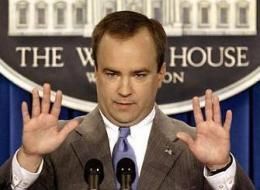
Even though it's everywhere today, next week's Scott McClellan tell-all about his time in the Bush Administration is going to continue to rock the political world for a little bit. I tend to trust people more when they stake their reputations and careers on venturing far off from expectations like this in order to tell the truth. Obviously, there are other factors afoot: 1) He is selling a book, 2) He needs to absolve his own actions from the shrinking man of the title of this post and the shrinking man's henchmen, and 3) He very likely has scores to settle either with colleagues in the Administration or media types that asked him the questions he calls softballs.
It is typical and sad to read the response from the White House as well as the former colleagues McClellan refers to. I am not sure to whom Karl Rove still appeals -- beyond Fox News-lovers -- but his credibility is near shot if it is not already. McClellan's claim that the Bushies governed as if on a campaign footing is not shocking to me because I'm u sed to it after all these years of "Bush's mandate" being thrown around, but it should not be shocking to anyone who remembers that a campaign -- i.e. political -- operative was given the governing post of deputy chief of staff. Firing U.S. attorneys for political reasons; leaking a CIA operative's name and then lying about it under oath; and now, among many other instances I could name, the former Alabama governor situation he has on his hands all are prime examples of McClellan's accusation.
Dana Perino should just pack her bags right now. She has to be the worst press secretary since Dee Dee Myers -- and not because she's a woman, Mary. Perino is probably worse, because I would assume Myers at least knew what the Cuban Missile Crisis was. Perino just looks like she is going to pee herself when she faces reporters, her voice is annoying and her answers pretty pathetic.
At least since Bush allegedly does not read newspapers, he appears pretty insulated from ever hearing about this book. Perino said he was informed about it, but at this point, that's exactly the kind of statement I do not believe. These people need to leave, fast.
UPDATE: Absent reading the book and only relying on media reports of it, I should not say that McClellan's words reinforce my current negative opinion of President Bush and his Administration. Also, his timing is very suspect. If Ari Fleischer is right that McClellan did not voice concerns or opposition to these issues when he was in the Administration, then how much does this matter now? It seems he is more concerned about washing his own hands of any culpability in the many controversies to which he spun denials, defenses and misdirection.
It is typical and sad to read the response from the White House as well as the former colleagues McClellan refers to. I am not sure to whom Karl Rove still appeals -- beyond Fox News-lovers -- but his credibility is near shot if it is not already. McClellan's claim that the Bushies governed as if on a campaign footing is not shocking to me because I'm u
 sed to it after all these years of "Bush's mandate" being thrown around, but it should not be shocking to anyone who remembers that a campaign -- i.e. political -- operative was given the governing post of deputy chief of staff. Firing U.S. attorneys for political reasons; leaking a CIA operative's name and then lying about it under oath; and now, among many other instances I could name, the former Alabama governor situation he has on his hands all are prime examples of McClellan's accusation.
Dana Perino should just pack her bags right now. She has to be the worst press secretary since Dee Dee Myers -- and not because she's a woman, Mary. Perino is probably worse, because I would assume Myers at least knew what the Cuban Missile Crisis was. Perino just looks like she is going to pee herself when she faces reporters, her voice is annoying and her answers pretty pathetic.
At least since Bush allegedly does not read newspapers, he appears pretty insulated from ever hearing about this book. Perino said he was informed about it, but at this point, that's exactly the kind of statement I do not believe. These people need to leave, fast.
UPDATE: Absent reading the book and only relying on media reports of it, I should not say that McClellan's words reinforce my current negative opinion of President Bush and his Administration. Also, his timing is very suspect. If Ari Fleischer is right that McClellan did not voice concerns or opposition to these issues when he was in the Administration, then how much does this matter now? It seems he is more concerned about washing his own hands of any culpability in the many controversies to which he spun denials, defenses and misdirection.
Subscribe to:
Comments (Atom)